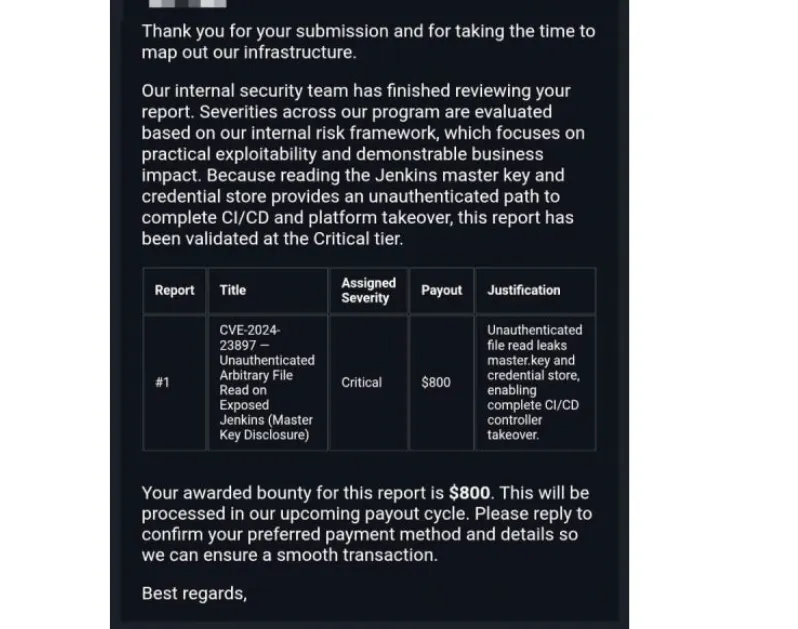
💰 How I Earned My First $5,000 Bug Bounty by Finding a Critical Authorization Flaw
By Rohith S

My first $5,000 bug bounty was an unforgettable milestone. 🚀
What made this finding interesting was that I didn't need a complicated exploit chain.
The root cause was a missing authentication/authorization boundary around a highly privileged backend function.
For responsible disclosure, I've intentionally redacted the organization, infrastructure, database, endpoint, query, and production data.
---
🔎 How I Found It
While testing an application within an authorized security program, I followed a simple process.
1️⃣ Mapped the application
I started by identifying interesting API and backend functionality exposed by the application.
2️⃣ Investigated an unusual backend function
I found a function that appeared to perform a privileged database-related operation.
That immediately raised a question:
«Who is actually allowed to call this function?»
3️⃣ Tested the authorization boundary
I sent a request without the expected authentication/authorization context.
Unexpectedly, the server still processed the request. 🚨
4️⃣ Safely validated the behavior
I used a harmless, read-only request to confirm whether the backend was actually performing the operation.
The real request is intentionally redacted:
curl -X POST "https://example.com/[REDACTED_FUNCTION]" \
-H "Content-Type: application/json" \
-d '{
"[REDACTED_PARAMETER]": "[REDACTED_READ_ONLY_QUERY]"
}'
The corresponding database query is also sanitized:
SELECT [REDACTED_COLUMN_1],
[REDACTED_COLUMN_2],
[REDACTED_COLUMN_3],
[REDACTED_COLUMN_4]
FROM [REDACTED_DATASET].[REDACTED_TABLE]
LIMIT 3;
The response returned legitimate production data, confirming that the backend was processing the request without the expected authorization.
«⚠️ All sensitive values above are intentionally redacted. The real endpoint, database identifiers, query, parameters, and response data are not disclosed.»
---
💥 Why Was It Critical?
The vulnerable backend function had access to a privileged production database.
That created a potentially serious impact across all three security properties:
🔴 Confidentiality — unauthorized access to application data.
🔴 Integrity — potential unauthorized insertion or modification of records.
🔴 Availability — potential destructive database operations affecting application functionality.
I did not execute destructive queries or modify production data.
I stopped after obtaining enough evidence to safely demonstrate the vulnerability.
---
🧠 The Interesting Part
The vulnerability wasn't simply:
«"An API doesn't require authentication."»
Get Rohith S’s stories in your inbox
Join Medium for free to get updates from this writer.
The bigger issue was the trust chain:
Unauthenticated Request → Privileged Backend Function → Production Database
A missing authorization check had exposed a highly privileged backend capability to an untrusted caller.
That's what made the finding much more serious.
---
📝 Responsible Disclosure
I reported the vulnerability with:
- Safe proof of concept
- Technical root cause
- Security impact
- Severity assessment
- Remediation recommendations
The security team investigated and validated the vulnerability.
The issue was subsequently addressed through the responsible disclosure process.
🏆 Final bounty: $5,000
---
🛠️ Recommended Remediation
Some important defensive measures for this type of issue are:
🔐 Enforce authentication
Privileged backend functions should never be anonymously accessible.
🛡️ Enforce server-side authorization
Don't rely on the frontend or client to decide who can perform privileged operations.
🔒 Apply least privilege
Backend services should only have the database permissions they actually require.
🚫 Don't expose database execution functionality to clients
Expose narrowly defined application actions instead of generic database execution capabilities.
⏱️ Prefer short-lived credentials
Avoid unnecessary long-lived static credentials for privileged services.
📊 Monitor privileged operations
Log and alert on unusual access to sensitive backend functionality.
---
🎯 What I Learned
This finding taught me an important lesson:
«Don't just ask, "Can I access this endpoint?"»
Ask:
«"What can this endpoint do if I shouldn't be able to access it?"»
When testing applications, I now pay particular attention to:
- Authentication boundaries
- Authorization checks
- Backend trust relationships
- Service-to-service permissions
- Privileged functions
- Excessive database permissions
Sometimes, a critical vulnerability isn't hidden behind a sophisticated exploit.
Sometimes, it's simply a missing security boundary.
---
💰 From Finding to $5,000
This was my first $5,000 bug bounty, and more than the reward, it reinforced why I enjoy vulnerability research.
Find the weakness.
Understand the impact.
Prove it safely.
Report it responsibly.
And most importantly — don't cross the line. 🔐
Thanks to the security team for handling the disclosure professionally.
— Rohith S
#BugBounty #CyberSecurity #Pentesting #EthicalHacking #AppSec #WebSecurity #VulnerabilityResearch #InfoSec #BugBountyHunter